
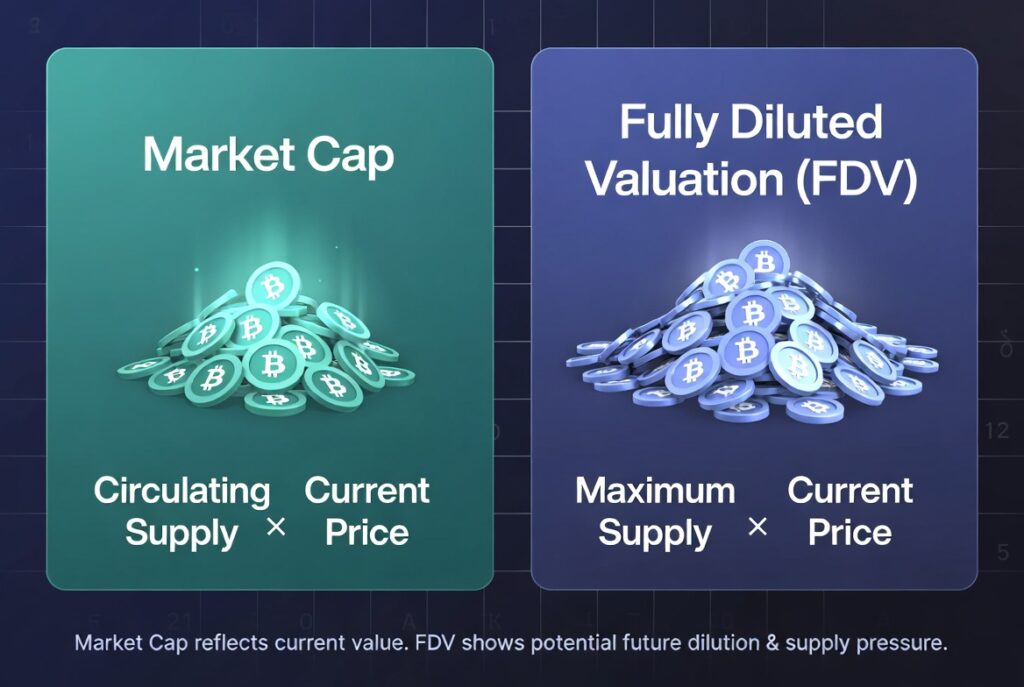
There’s a metric that experienced crypto investors check religiously before putting money into any new project, and a lot of beginners don’t even know it exists. It’s called fully diluted valuation (FDV) and understanding the difference between market cap vs fully diluted valuation is one of the most practically useful things you can learn about evaluating crypto investments.
The gap between these two numbers has trapped countless retail buyers into investments that looked cheap on the surface but were quietly set up to underperform. This guide explains exactly what both metrics mean, why they diverge, and how to use that divergence to make smarter decisions.
Market Cap: The Number Everyone Sees
Market capitalisation is the figure plastered across every crypto tracker and exchange. The formula is simple:
- Market Cap = Current Price x Circulating Supply
Circulating supply is the number of tokens that are currently available and trading in the market. It excludes tokens that are locked, vesting, reserved for the team, set aside for future ecosystem development, or otherwise not yet in circulation.
Market cap gives you a reasonable snapshot of the current size of a project – how much the market collectively values the tokens that exist right now. It’s useful for comparing projects and understanding relative scale. But it only tells you part of the story, and for many newer projects, it’s the more flattering part.
Fully Diluted Valuation: The Number That Really Matters
Fully diluted valuation takes the same calculation but uses the maximum total supply instead of the circulating supply:
- FDV = Current Price x Maximum Total Supply
Maximum total supply is every token that will ever exist. This includes the ones currently locked in vesting schedules for the team, investors, advisors, ecosystem funds, and future emissions. It’s the complete picture of how many tokens are eventually coming to market.
When you look at FDV, you’re asking: if every token that will ever exist were in circulation right now at the current price, how much would this project be worth? That question often reveals a very different number from the market cap and that difference is where things get interesting.
Why the Gap Between Market Cap and FDV Is So Important
Here’s where this becomes genuinely practical. Many crypto projects, particularly newer ones launch with a small percentage of their total token supply in circulation. This keeps the initial market cap looking modest and accessible. But the FDV, which reflects the total token supply at current prices, can be dramatically higher.
Why does that matter to you as a buyer? Because those locked tokens are coming. The team tokens will vest. The investor allocations will unlock. The ecosystem fund will be deployed. When they arrive in the market, they represent new supply that existing holders are diluted by and if there isn’t proportionally more demand arriving at the same time, the price comes under pressure.
A concrete example helps make this real. Imagine a token with:
- Current price: $1.00
- Circulating supply: 100 million tokens
- Maximum supply: 2 billion tokens
- Market cap: $100 million – looks reasonable
- FDV: $2 billion – 20 times the current market cap
That FDV of $2 billion means the market is implicitly pricing the fully diluted project at $2 billion, if it were to reach that scale. Whether that’s justified depends on the project, but the key takeaway is that 1.9 billion more tokens are going to enter the market at some point. That’s enormous future supply pressure if demand doesn’t keep pace.
The Red Flags to Watch For
Not every high FDV-to-market-cap ratio is a problem. Early-stage projects with genuine long-term potential can justify a high ratio if the fundamentals support the valuation at full dilution. But there are specific patterns that should make you cautious.
Very Low Float with Very High FDV
Float refers to the percentage of total supply that is currently circulating. A token with 3% float and an FDV of $500 million is a project where 97% of the tokens are still locked. When those tokens unlock and they will, the selling pressure can be severe unless the project has grown dramatically to absorb the additional supply.
Low float launches are sometimes done deliberately to create artificial scarcity at launch and generate early price momentum. The project looks like it’s performing well on market cap metrics, but the FDV tells you the real implied valuation and often it’s wildly optimistic for what the project has actually built.
Aggressive Vesting Cliffs Approaching
Vesting schedules determine when locked tokens become available. A cliff is a specific date when a large batch of tokens unlocks all at once. When a team or investor cliff is approaching, it creates a predictable supply event.
It doesn’t automatically mean the price will crash. Sometimes teams are long-term believers who don’t sell immediately. But it does create potential selling pressure, and sophisticated traders often position accordingly ahead of known unlocks. Always check the vesting schedule before investing in any project where team and investor tokens represent a significant portion of the total supply.
FDV Higher Than Established Comparable Projects
This is one of the clearest signs of overvaluation hiding behind a modest market cap. If a brand-new DeFi protocol has an FDV of $3 billion at launch, but established protocols with five years of track record and billions in TVL are trading at $1 billion market caps, the new project is being priced at a significant premium to far more proven competition.
The market cap might look small and tempting. But the FDV reveals what you’re actually paying for the project on a fully diluted basis and sometimes that number doesn’t survive comparison with reality.
When a High FDV-to-Market-Cap Ratio Is Justified
It’s not all doom and gloom. There are scenarios where a high ratio makes genuine sense:
- Early-stage infrastructure projects where most tokens are reserved for long-term ecosystem development and won’t unlock for years
- Projects with aggressive token burning mechanisms that will reduce total supply over time, compressing the FDV
- Teams with proven track records where vesting serves as a genuine long-term alignment mechanism rather than a deferred sell opportunity
- Tokens where the unlocking schedule is gradual and spread across many years rather than concentrated in near-term cliffs
The key is to understand what the unlocking schedule actually looks like and to assess whether the project’s growth trajectory is realistic enough to absorb that future supply. A project growing 10x in usage per year can handle a lot of token unlocks. A project with stagnant metrics cannot.
How to Check These Numbers
Most crypto data platforms display both market cap and FDV on token pages. When you’re researching any project, make these part of your standard checklist:
- Find the FDV on a reputable data aggregator and compare it to the market cap. The ratio tells you the float percentage
- Look up the token’s vesting schedule – many projects publish this in their documentation or tokenomics page; third-party sites like Token Unlocks track upcoming unlock events
- Check how the FDV compares to direct competitors in the same sector at full dilution
- Ask whether the project’s current traction – users, revenue, TVL, developer activity justifies the FDV, not just the market cap
Summary
The difference between market cap vs fully diluted valuation is one of those concepts that seems technical but has very practical consequences for your portfolio. A coin that looks modestly valued on market cap can be aggressively priced at full dilution and those future token unlocks will arrive whether the project has earned that valuation or not.
Make FDV a standard part of your research process. Compare it to direct competitors. Check the vesting schedule. Understand what percentage of the total supply is currently in circulation and when the rest is coming. It takes five extra minutes and it will save you from a category of mistake that catches out retail investors over and over again.
Price per token is a number. Market cap is a snapshot. FDV is the honest question: what are you actually buying, at what implied total valuation, and can the project realistically grow into it?